If you are considering travelling to India for evaluation or treatment of a heart-valve condition, organising the visa is an important part of your preparation. The exact route can depend on your nationality, passport, treatment plan and the Indian Mission handling your application.
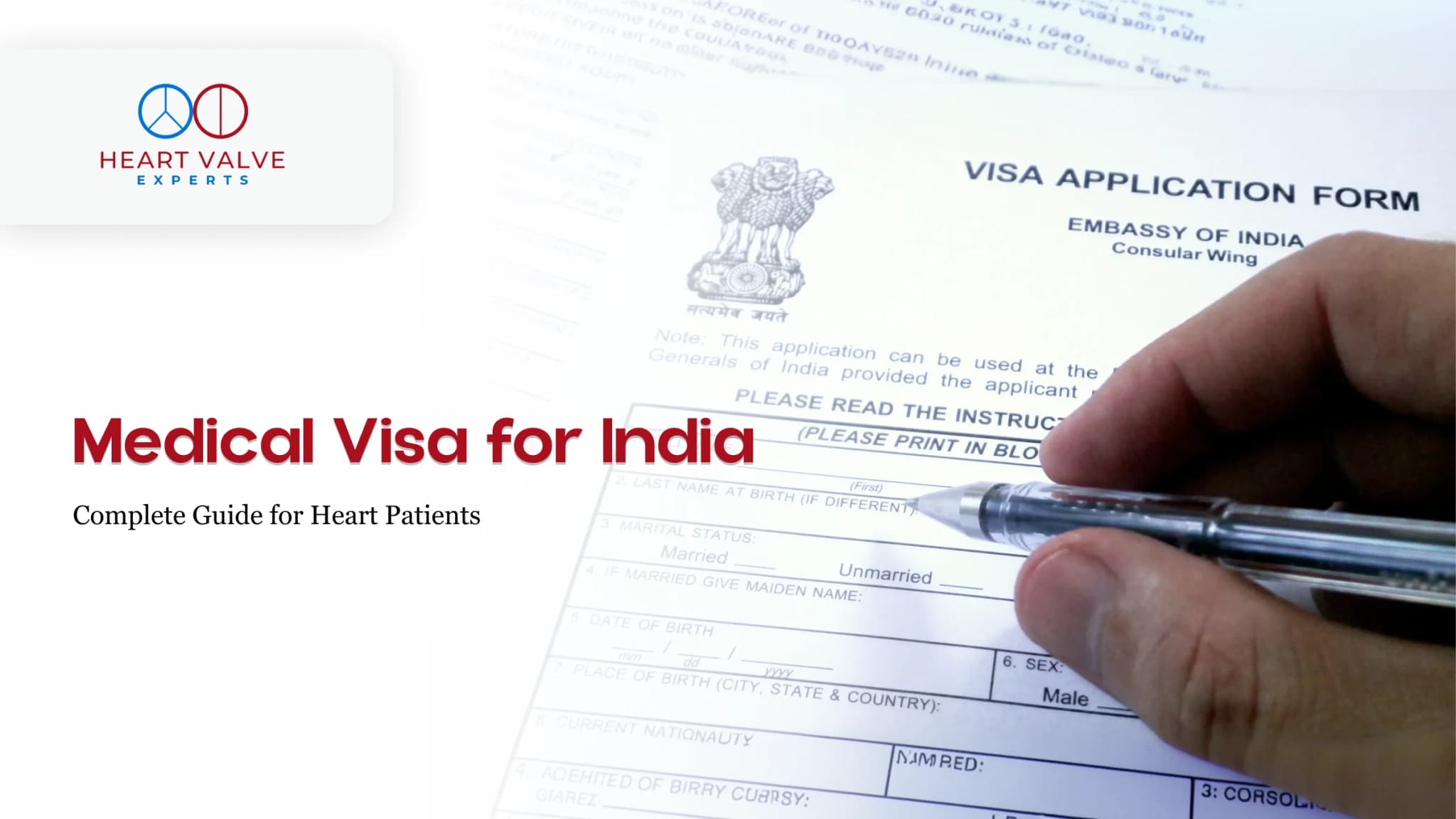
A medical visa for India is intended for eligible foreign nationals travelling to India for medical treatment. Depending on the applicable visa route, a caregiver may be able to travel on a Medical Attendant Visa linked to the patient’s medical visa. Government rules and country-specific requirements can change, so always check the official Indian visa portal and the Indian Embassy or High Commission responsible for your place of application before submitting documents.
This guide explains the process, the hospital documents you may need and how heart patients and caregivers can prepare for travel.
Important: A hospital invitation or treatment letter does not guarantee a visa. Visa issuance is decided by the Government of India and the relevant Indian Mission or immigration authorities. The Embassy of India in Muscat, for example, explicitly states that visa issuance is a government prerogative and not a right of the applicant.
Foreign nationals travelling specifically to India for planned medical treatment may need an appropriate medical visa, depending on their nationality and circumstances.
For heart patients, this may include travel for specialist evaluation or planned treatment at a recognised Indian hospital. Before applying, confirm which visa route applies to your passport rather than assuming that another patient’s process will be the same.
The Government of India’s e-Visa system currently includes e-Medical Visa and e-Medical Attendant Visa categories. Check the eligibility list and current conditions on the official Government of India e-Visa portal when you apply.
Patients using the regular paper-visa route should follow the instructions of the Indian Mission responsible for their country or place of residence.
The Medical Visa/e-Medical Visa is for the person travelling to India for treatment.
The Medical Attendant Visa/e-Medical Attendant Visa is for an eligible person accompanying the patient. The central Government of India e-Visa portal currently states that up to two e-Medical Attendant Visas may be granted against one e-Medical Visa.
Requirements can differ for regular visas. For example, the Embassy of India in Muscat states that up to two attendants who are blood relatives may accompany a medical-visa applicant.
Do not assume that every caregiver automatically qualifies. Check the rules applying to your nationality and visa route.
There is no single checklist that should be assumed to apply identically to every applicant. Requirements may differ by Indian Mission and individual circumstances.
However, official Indian Mission guidance shows that applicants may be asked for documents such as:
For example, the High Commission of India in Nairobi asks medical-visa applicants for an Indian hospital invitation containing information including the patient/attendant details, passport numbers, illness, expected treatment duration and estimated treatment cost. It also requests medical documents, a local referral and evidence of sufficient funds. Additional documents may be requested by the consular officer.
Passport requirements should be checked against the visa route you are using. For the Government of India e-Visa route, the passport should have at least six months’ validity at the time of application. The official e-Visa guidance also asks travellers to have a return or onward ticket and sufficient funds for their stay.
Check these requirements before paying for non-refundable travel arrangements.
Your Indian hospital may be asked to provide documentation confirming the proposed medical visit.
The exact contents depend on the Mission. Nairobi’s official medical-visa guidance, for example, asks for an invitation from an approved hospital or recognised doctor identifying the patient and attendant, passport details, illness, treatment duration and estimated cost.
For applicants in Oman, the Embassy of India lists an Indian hospital appointment/visa invitation letter and a recent local medical report with confirmation of consultation or appointment among its medical-visa requirements.
Ask the international-patient team which hospital documents can be provided for your application. The hospital can support the documentation process, but cannot approve or guarantee your visa.
CTA: Share your reports and ask about hospital documents for your visa application.
Button: Explore International Patient Guidance
The precise procedure depends on whether you are eligible for an e-Visa or need to follow a regular visa process.
For eligible e-Visa applicants, the Government of India describes four broad steps: complete the online application and upload the required passport/photo documents, pay the applicable fee online, receive the Electronic Travel Authorization (ETA) electronically if granted, and carry a printed ETA when travelling to India.
For e-Medical and e-Medical Attendant applications, the central portal currently says eligible applicants may apply at least four days before arrival, within the application window specified on the portal.
For a regular visa, follow the instructions of the relevant Indian Mission. Some Missions require appointments, biometrics, original documents or additional evidence. Payment of a fee should never be interpreted as confirmation that a visa will be issued.
Because visa conditions are time-sensitive, check the official portal again immediately before applying.
Visa authorities may request medical evidence establishing the need for treatment in India. Your hospital’s international-patient or cardiac team may also need medical information to understand your case before issuing appropriate treatment-related documentation.
Depending on what is available in your case, organise copies of your recent cardiology records, investigation reports, previous procedure or operation records, discharge summaries and your current treatment information. If the relevant Indian Mission requires a local doctor’s referral, obtain that separately.
For patients returning to India for follow-up care, keep previous Indian hospital documents readily available. Nairobi’s current guidance specifically asks follow-up patients to attach previous medical papers and their Indian hospital discharge summary.
Patient-safety note: Visa preparation should not delay urgent medical care. If you develop severe or rapidly worsening symptoms while arranging travel, seek urgent medical assessment where you are rather than waiting to travel internationally.
Once the appropriate visa has been issued and your treating team considers you suitable to travel, keep your essential documents together.
Before departure, check your passport and visa/ETA details, hospital appointment information, medical records, medication documentation, travel arrangements and caregiver documents. Keep important medical information and medicines in your hand luggage where airline and security rules permit, rather than relying only on checked baggage.
Also confirm whether vaccination or other entry-health documentation applies to your departure country. For example, the High Commission of India in Nairobi currently asks visa applicants to ensure they have valid Yellow Fever and Polio vaccination cards.
For questions about fitness to fly, medication timing during travel, oxygen needs or other cardiac precautions, obtain individual advice from your treating clinician and airline before departure. These decisions depend on your medical condition and planned journey.
Medical visa requirements depend on your nationality and the Indian Mission handling your application. Check the latest instructions from the relevant government service before submitting documents or making travel bookings.
Bangladesh: The Government of India’s Bangladesh visa portal lists Medical Visa as a category. Applicants should check the current requirements for specialised treatment and an advance appointment. If you are considering heart-valve assessment in Mumbai, see how patients from Bangladesh can begin a specialist review.
Kenya: The High Commission in Nairobi publishes a Medical Visa and Medical Attendant checklist covering hospital invitations, medical documents, financial evidence and attendant details. Before making travel arrangements, you can request a heart-valve review from Kenya using the records you already have.
Nigeria: Nigerian passport holders should confirm the current medical-visa application route with the Indian Mission responsible for their application. Eligibility and document requirements can change, so check the latest instructions before making travel bookings.
Somalia: Somali nationals should verify the current application route and document requirements with the Indian Mission serving their application.
Oman: Applicants should check whether the e-Visa or regular paper Medical Visa route applies to their circumstances.
If you are also planning a heart-valve assessment in Mumbai, HVE’s international patient guidance explains how to share your records before travelling and provides country-specific care information.
The visa is only one part of preparing for heart surgery in India or another planned cardiac treatment. Before confirming travel, patients should understand why the treatment is being considered, what further evaluation may be needed in India and what the expected treatment and recovery pathway may involve.
If you already have medical reports and would like a specialist review before making travel arrangements, you can explore an expert opinion for heart surgery.
CTA: Get clarity on your heart-valve condition before planning travel.
Button: Request an Expert Opinion
No. A hospital may provide an invitation, appointment or treatment-related letter where appropriate, but it cannot guarantee visa approval. Visa issuance remains the decision of the Government of India and relevant authorities.
An eligible caregiver may be able to apply for a Medical Attendant Visa. Under the current central e-Visa guidance, up to two e-Medical Attendant Visas may be granted against one e-Medical Visa. Requirements for regular visas can differ, so verify the applicable Mission’s rules.
The Government of India e-Visa portal currently says eligible e-Medical and e-Medical Attendant applicants may apply at least four days before arrival within the permitted application window. Do not leave an important medical journey until the minimum deadline; processing or additional-document requests may affect your plans.
Official Mission requirements commonly include hospital documentation for a medical visa. The exact format and information required vary, so check the responsible Mission before requesting the letter.
Avoid assuming that submitting an application means the visa will be issued. Follow the documentary and travel requirements of your applicable Mission and consider the financial consequences of non-refundable bookings. A visa application or hospital invitation is not an approval guarantee.
Visa information is time-sensitive. Last reviewed: 7 September 2026. Requirements, eligibility, fees, validity periods, documentation and processing procedures may change. Always confirm the current rules with the Government of India or the Indian Embassy/High Commission responsible for your application before travelling.
References

About The Author
With over 15 years of expertise, Dr. Phatarpekar is recognised as a renowned interventional cardiologist in Mumbai, specialising in complex coronary interventions, structural heart procedures, and pioneering work in Transcatheter Aortic Valve Implantation (TAVI).
● Blogs