
Tricuspid Regurgitation Treatment
Table of Contents
- What Is the Treatment for Tricuspid Regurgitation?
- Medicines for Tricuspid Regurgitation
- Tricuspid Valve Surgery
- Tricuspid Valve Repair
- Transcatheter Treatment for Tricuspid Regurgitation
- How Do Doctors Choose the Right TR Treatment?
- Can Tricuspid Regurgitation Be Treated Without Open-Heart Surgery?
- What Happens If Tricuspid Regurgitation Is Left Untreated?
- Frequently Asked Questions
- References

Medically Reviewed By
Dr. Ankur U. Phatarpekar
Get A Call Back
Tricuspid regurgitation treatment depends on how severe the valve leak is, whether you have TR symptoms, how well the right side of your heart is working and your overall health. Treatment may include medicines, regular monitoring, tricuspid valve repair or replacement, or a transcatheter procedure for selected patients.
If you have been told that you have moderate or severe tricuspid regurgitation, you may be wondering, “Do I need treatment now, or can I wait?” The answer is not based on the echocardiogram alone. Your cardiologist looks at the valve, right ventricle, symptoms, other heart conditions and your surgical risk before recommending the next step.
What Is the Treatment for Tricuspid Regurgitation?
Treatment for tricuspid regurgitation may include medicines to control fluid buildup, treatment of conditions contributing to the valve leak, surgery to repair or replace the valve, or transcatheter treatment in selected patients.
Mild TR without symptoms may only need regular follow-up. When TR becomes severe or starts affecting the right side of the heart, treatment may need to be considered more actively.
Current guidelines recommend considering intervention in selected patients with severe TR, particularly when symptoms or changes in right-heart function are present. (Vahanian et al., 2025
The main treatment options are:
| Treatment | What It Does |
| Medicines | Reduce fluid buildup and symptoms |
| Treating the cause | Manages conditions worsening TR |
| Valve repair | Repairs the leaking valve |
| Valve replacement | Replaces a damaged valve |
| TEER | Reduces leakage using a catheter |
| TricValve | Reduces venous congestion in selected patients |
The right treatment is different for each patient. A person who can safely undergo surgery may have different options from someone who is older or has several other medical problems.
Medicines for Tricuspid Regurgitation
Medicines can help control the effects of tricuspid regurgitation, especially when fluid has started building up in the body. They do not directly repair the leaking tricuspid valve.
Diuretics, often called water tablets, may be used to reduce excess fluid. They can help with swelling and congestion and may make breathing and daily activities more comfortable.
Your doctor may also treat conditions that are contributing to the valve problem. For example, atrial fibrillation, left-sided valve disease, pulmonary hypertension or heart failure may need specific treatment.
The medicines you receive depend on your overall heart and kidney function. Your doctor may also monitor blood pressure, kidney function and electrolyte levels while adjusting treatment.
If significant TR continues to cause symptoms despite appropriate medical treatment, your cardiologist may discuss whether a valve procedure should be considered.
Tricuspid Valve Surgery
Tricuspid valve surgery may involve repair or replacement.
Repair is generally considered when the valve can be corrected effectively. If the valve is too damaged to repair, replacement may be considered.
Surgery can provide an effective way to treat severe TR, but it is not suitable for everyone. Previous heart surgery, age, kidney disease, lung disease, severe right-heart dysfunction and other medical conditions can increase surgical risk.
“Not every patient with severe TR is fit for surgery. We look at their age, other health problems and the condition of the right side of the heart before deciding which treatment is safest.”
Dr. Tanmay Kulkarni, MBBS, MD, DM (Gold Medalist)
Structural Interventional Cardiologist, Pune
This is why your cardiologist may ask for detailed imaging and other tests before recommending surgery.
For isolated severe TR, current guidelines support surgery in appropriately selected symptomatic patients when severe right ventricular dysfunction or severe pulmonary hypertension is not present.
The timing also matters. Waiting until the right side of the heart has become severely weakened can make treatment more difficult.
Tricuspid Valve Repair
Tricuspid valve repair means treating the existing valve so that less blood leaks backward.
During surgical repair, the surgeon may reduce the size of the valve ring, repair the valve leaflets or use other techniques depending on what is causing the leak.
The decision depends on the valve anatomy, cause of TR and the condition of the right side of the heart.
If you have significant TR and are being evaluated for another heart valve operation, your heart team may assess the tricuspid valve at the same time.
Transcatheter Treatment for Tricuspid Regurgitation
Transcatheter treatment uses a catheter to treat the valve without conventional open-heart surgery.
These procedures may be considered for selected patients with severe symptomatic TR, particularly when the risk of surgery is high.
Data from the international TriValve registry showed that transcatheter tricuspid valve interventions were associated with improvements in symptoms and functional status in high-risk patients. (Taramasso et al., 2019)
The exact procedure depends on the anatomy of the tricuspid valve and the patient’s overall condition.
TEER for Tricuspid Regurgitation
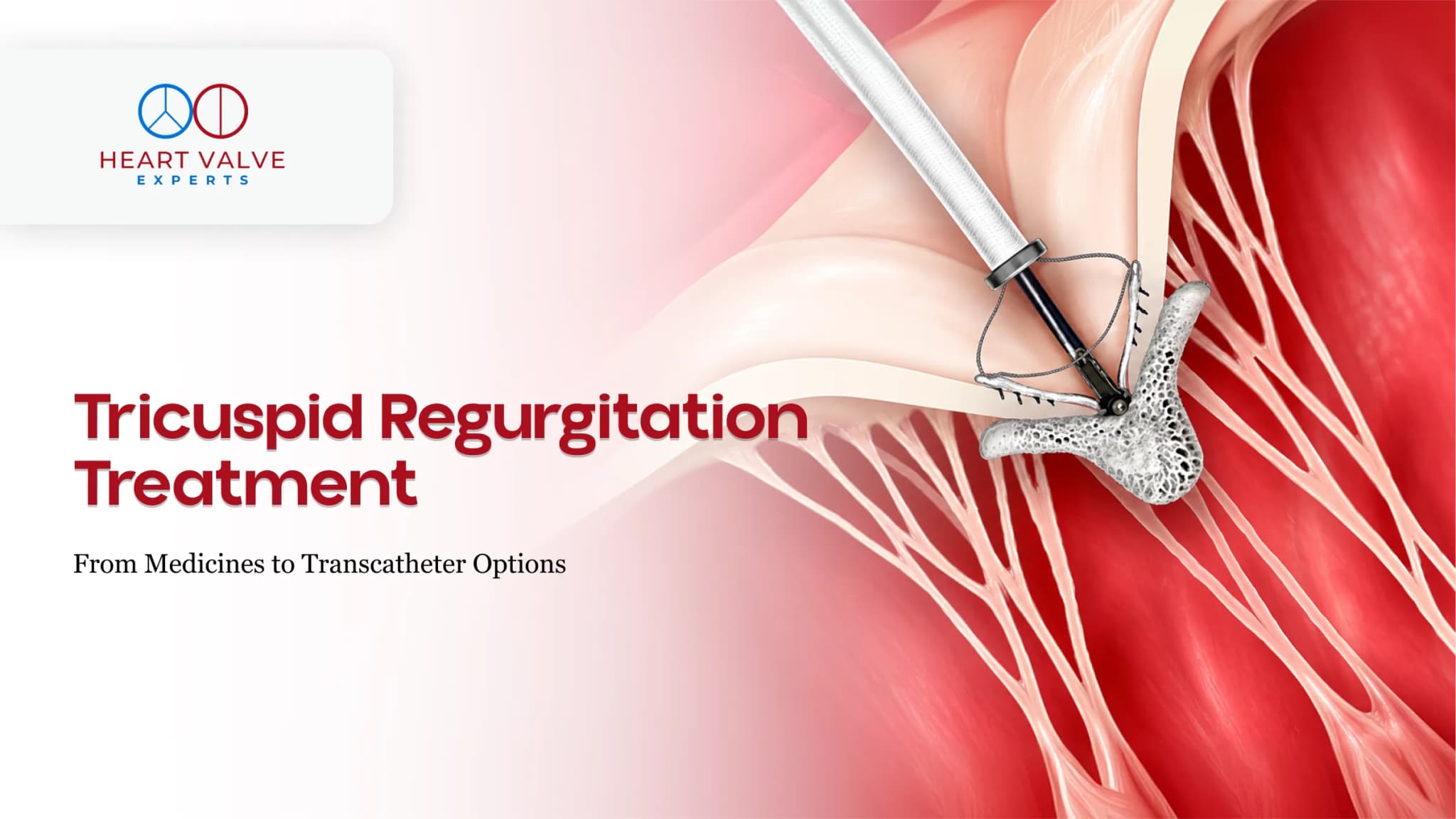
Tricuspid transcatheter edge-to-edge repair, or TEER, uses a catheter to bring parts of the valve leaflets closer together. This can reduce the amount of blood leaking backward through the valve.
The catheter is usually introduced through a vein and guided toward the heart. Imaging helps the cardiology team position the device accurately.
Clinical research has shown that transcatheter tricuspid interventions can improve symptoms and quality of life in appropriately selected high-risk patients. (Sorajja et al., 2023)
Your heart team may therefore review detailed echocardiography before deciding whether TEER is technically suitable.
TricValve and Other Transcatheter Options
Some patients with severe TR have anatomy that makes direct treatment of the tricuspid valve difficult. Others may have a very high risk for conventional surgery.
For selected patients in this situation, caval valve implantation may be considered.
TricValve is a transcatheter system that places valves in the superior and inferior vena cava. Instead of directly repairing the leaking tricuspid valve, the treatment aims to reduce the backward flow of blood into the major veins and relieve venous congestion.
In the 2025 TricBicaval Registry, which included 204 high-risk patients with severe tricuspid regurgitation, TricValve implantation was associated with improved functional status, reduced signs of right-heart failure and fewer heart-failure hospitalisations during follow-up. (Sánchez-Recalde et al., 2025)
However, TricValve is not a treatment for every person with TR. It is generally considered for carefully selected patients after assessment of their anatomy, symptoms, right-heart function and suitability for other transcatheter or surgical options.
How Do Doctors Choose the Right TR Treatment?
There is no single treatment that is best for every patient with tricuspid regurgitation.
Your heart team may follow a decision process like this:
This assessment is especially important when TR is severe.
Your echocardiogram may include detailed views of the valve and right ventricle. In some patients, transoesophageal echocardiography, CT or other imaging may be needed before a transcatheter procedure.
The treatment decision also considers your symptoms, right-heart function, quality of life and the likelihood that the chosen treatment will provide meaningful benefit.
Can Tricuspid Regurgitation Be Treated Without Open-Heart Surgery?
TEER can reduce leakage by bringing the valve leaflets closer together. Other transcatheter approaches, including caval valve implantation with systems such as TricValve, may be considered for specific high-risk patients.
These procedures are not automatically safer or better for everyone. Suitability depends on valve anatomy, severity of TR, right ventricular function, pulmonary pressures, other medical conditions and previous procedures.
A structural heart or valve team can compare the available options and explain which approach fits your situation.
What Happens If Tricuspid Regurgitation Is Left Untreated?
Mild TR may remain stable and may only require follow-up. Significant TR can be different.
As the valve leak progresses, the right side of the heart may become enlarged or weakened. Fluid can also build up in the veins and tissues, causing increasing congestion.
This does not mean that every person with severe TR will need a procedure immediately. It does mean that significant TR should be monitored carefully so that changes in symptoms and right-heart function are identified early.
If your echocardiogram shows moderate or severe tricuspid regurgitation, speak with a cardiologist about what the finding means for you.
Take your previous echocardiograms and other heart reports to the appointment if you have them. Comparing older and newer reports can help your doctor see whether the valve leak or right-heart function has changed.
If you have increasing swelling, breathlessness, reduced stamina or repeated hospital visits for fluid buildup, ask whether you need a more detailed valve assessment.
At Heart Valve Experts (HVE), a valve-focused evaluation can review the severity of TR, right ventricular function, valve anatomy and your overall treatment risk. This helps the heart team determine whether continued medical treatment and follow-up are appropriate or whether valve repair, surgery or a transcatheter option should be considered.
Frequently Asked Questions
Can tricuspid regurgitation be cured?
Some cases can be effectively treated with valve repair or replacement. Transcatheter procedures can also reduce the effects of significant TR in selected patients.
Do medicines repair tricuspid regurgitation?
No. Medicines mainly help control fluid buildup and related symptoms. They do not directly repair the leaking valve.
When does tricuspid regurgitation need surgery?
Surgery may be considered for severe TR when symptoms are present or when the right ventricle is becoming enlarged or its function is declining, provided the patient is an appropriate surgical candidate.
What is TEER for tricuspid regurgitation?
TEER is a catheter-based procedure that brings parts of the tricuspid valve leaflets together to reduce the amount of blood leaking backward.
What is TricValve?
TricValve is a transcatheter bicaval valve system that places valves in the superior and inferior vena cava. It may be considered for selected patients with severe TR who are not suitable for other treatment approaches.
Can severe tricuspid regurgitation be treated without open-heart surgery?
Yes. Selected patients may be candidates for transcatheter treatments such as TEER or caval valve implantation.
How do doctors decide between surgery and a transcatheter treatment?
They consider the severity and cause of TR, symptoms, valve anatomy, right ventricular function, pulmonary pressure, age, other medical conditions and surgical risk.
References
Blasco-Turrión, S. et al. (2024) ‘Bicaval TricValve implantation in patients with severe symptomatic tricuspid regurgitation: 1-year follow-up outcomes’, JACC: Cardiovascular Interventions, 17(1), pp. 60–72.
Sánchez-Recalde, A. et al. (2025) ‘Bicaval TricValve implantation in patients with severe tricuspid regurgitation: 1-year outcomes from the TricBicaval Registry’, JACC: Cardiovascular Interventions, 18(15), pp. 1913–1924.
Sorajja, P. et al. (2023) ‘Transcatheter repair for patients with tricuspid regurgitation’, New England Journal of Medicine, 388(20), pp. 1833–1842.
Taramasso, M. et al. (2019) ‘Outcomes after current transcatheter tricuspid valve intervention: mid-term results from the International TriValve Registry’, JACC: Cardiovascular Interventions.
Vahanian, A. et al. (2025) ‘2025 ESC/EACTS Guidelines for the management of valvular heart disease’, European Heart Journal. doi: 10.1093/eurheartj/ehaf194.

About The Author
Dr. Ankur U. Phatarpekar M.D., D.M., FSCAI
With over 15 years of expertise, Dr. Phatarpekar is recognised as a renowned interventional cardiologist in Mumbai, specialising in complex coronary interventions, structural heart procedures, and pioneering work in Transcatheter Aortic Valve Implantation (TAVI).
● Blog
Related Heart Valve Experts (HVE) Blog

Tricuspid Regurgitation Treatment
Tricuspid Regurgitation Symptoms and The Right-Heart Warning Signs

What Is Tricuspid Regurgitation and What Does It Mean for Your Heart?

Severe Tricuspid Regurgitation and Treatment
Mitral Stenosis vs Mitral Regurgitation: Differences in Symptoms, Echo Findings and Treatment